It had been almost three months since we started from my hometown of Adelmannsfelden in Germany, and we had traversed ten countries, when we finally entered the last country on our itinerary on the 30th of July, 2011. Continue reading “South Africa: The Rainbow Nation”→
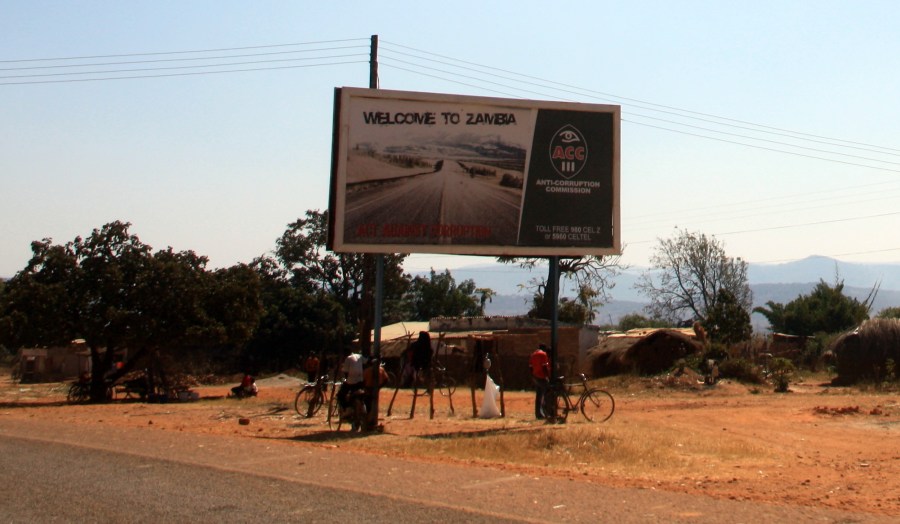
We left Malawi and entered Zambia through the Mchinji border crossing on the 21st of July, and then made a stop in Chipata, the capital of the Eastern Province of Zambia. The city boasts fancy hotels, restaurants, and shopping malls, and an abundance of banks and ATM machines. This was quite a contrast to where we just came from. It is an observation we made throughout our journey, that things suddenly and often surprisingly change as one crosses borders. Continue reading “Victoria Falls, and free-roaming lions in Botswana”→
We had just crossed the Kenyan-Tanzanian border at Namanga and were about to enter the town limits of Longido, when suddenly a car rolled onto the highway. The elderly driver saw us, probably panicked, and stopped his car, blocking the narrow highway in its entirety. I had no option but to slam on the brakes, but it was too late. We crashed into the car’s side, were thrown over the car, and hit the asphalt. Continue reading ““Welcome to Africa!””→
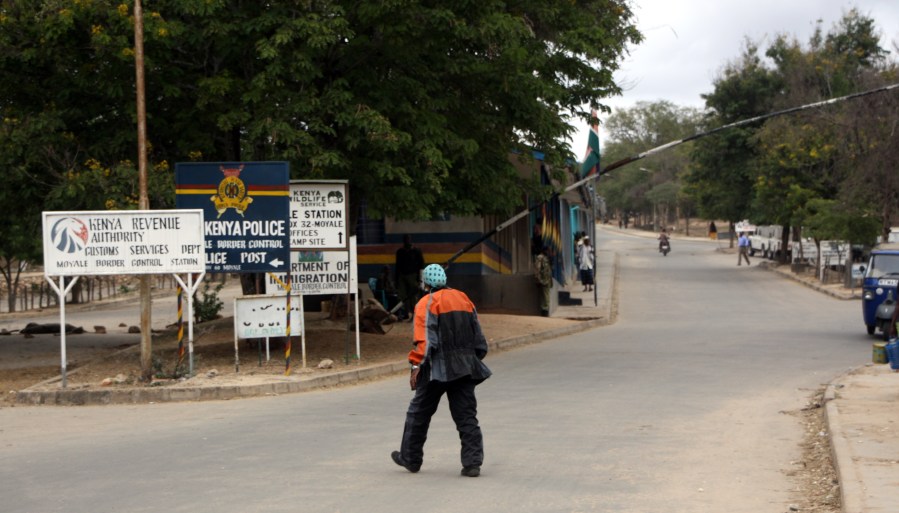
We spent the night of the 20th of June in the border town of Moyale, and headed out for Marsabit in northern Kenya in the morning. As we rode from one country into the other, the asphalt road ended. We did not think much of it at the time. The first 120 kilometers on the dirt road were easy and fun, and brought us to the village of Turbi. But then, as we entered the Dide Galgalu Desert, the troubles began. Continue reading “Stranded in the Kenyan desert, and a visit to the land of the Maasai”→
The terrain of Sudan is generally flat, and the climate is dry and extremely hot, whereas Ethiopia is mountainous, hence sometimes referred to as the Roof of Africa, making it considerably cooler than other regions around the globe at a similar latitude. Around the border at Gallabat/Metema, that contrast is particularly stark, and experiencing it as we crossed the border was amazing. Within a short distance, the sparse desert landscape turned into a dense collection of abundantly green hills, valleys, and mountains, and the scorching heat gave way to a mild breeze. Continue reading “The Simien Mountains, and the first hijra in Islam”→
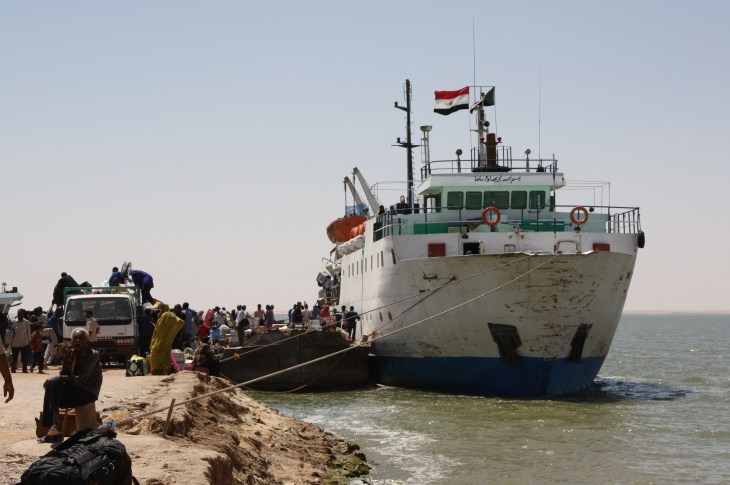
Signaling the warming up of relations between Egypt and Sudan, a land border crossing between the two nations was opened in 2014. Three years prior, however, when we did our motorcycle trip through Africa, the only way to get from Egypt to Sudan was by ferry.
Last time, we left off at the Egyptian desert highway from Alexandria to Giza. The distance between the two cities is only a little over 200 kilometers, and it did not take us long to reach our destination.
Do you speak African? Well, neither do the more than one billion people living in Africa, where about 2,000 different languages are spoken, none of which is called “African.” Too often, people think of Africa as if it was a single country, defined by disease, poverty, hopelessness, and corruption. This tiring image is at best misleading, and has little to do with reality. In fact, Africa is all but monolithic, and arguably the most diverse continent of all. Africa is home to 15 percent of the world’s population and an incredibly large number of ethnicities and cultures, the second largest continent in terms of both area and population, and consists of at least 54 countries. Three of the ten economies forecasted to be the fastest-growing in 2016 by the Economist Intelligence Unit are located in Africa, and 25 Nobel Laureates were born there.
In 2011, I rode my motorcycle, a BMW R 1150 GS, from my hometown of Adelmannsfelden in Southwest Germany to Cape Town in South Africa. I was accompanied by my friends Marc (on a BMW R 1100 GS) and Cathleen (on a BMW F 650 GS), and my wife Khukie, with whom I shared my motorcycle. We left Adelmannsfelden on the 10th of May, and we reached Cape Town on the 7th of August. We covered a total of approximately 13,000 km, crossing through twelve countries: Germany, Austria, Italy, Egypt, Sudan, Ethiopia, Kenya, Tanzania, Malawi, Zambia, Botswana, and South Africa. This is a photo/video report of our adventures along the way.
This letter to the editor was published in the Schwäbische Post on November 5, 2015. Versions of it appeared on the same day in the Gmünder Tagespost and the Ipf- und Jagst-Zeitung.
Each one of us encounters animals every day, if only as a piece of meat on a plate, and yet most of us hardly spare a thought for them. Shafayat Nazam Rasul must hence be commended for his Tuesday op-ed, in which he drew our attention to the complicated relationship between humans and other animals, and started a conversation that I think is very important. In the course of doing so, he mentioned a number of common objections to the idea that non-human animals are our moral equals and have rights. It is unfortunate, however, that these objections remained unanswered, as readers might have gotten the impression that animal rights advocates “spew an extreme,” as the author rather uncharitably stated, and do not have good arguments. By responding to some of the objections, I want to show that the philosophy of animal rights is in fact a well-thought-out moral theory worthy of our serious attention. Continue reading “Animal Rights: Objections, Myths, and Misconceptions”→
Today is the first birthday of Avijit Roy that we commemorate without him. His life was taken by Islamic terrorists earlier this year, when he was in Bangladesh to attend the Ekushey Book Fair. Avijit was a prolific and accomplished author, a fierce defender of human rights, and dedicated much of his life to the promotion of freethinking, humanism, and rationalism. Continue reading “Commemorating Avijit Roy on his 44th birthday”→
Last year, a Pew Research Center survey found that Americans have a significantly less favorable view of atheists than of Jews, Christians, Buddhists, and Hindus. Only Muslims were rated more negatively than atheists. That is consistent with another survey conducted by the same institute in the same year, which found that about every second American would not be happy with a family member marrying an atheist. In a 2012 Gallup poll among Americans, 43 percent of respondents said that they would not vote for a presidential candidate who is an atheist. Simply put, Americans do not like atheists. As everybody knows who knows anything about Bangladesh, neither do Bangladeshis. Continue reading “Atheists ain’t bad people; neither are theists”→
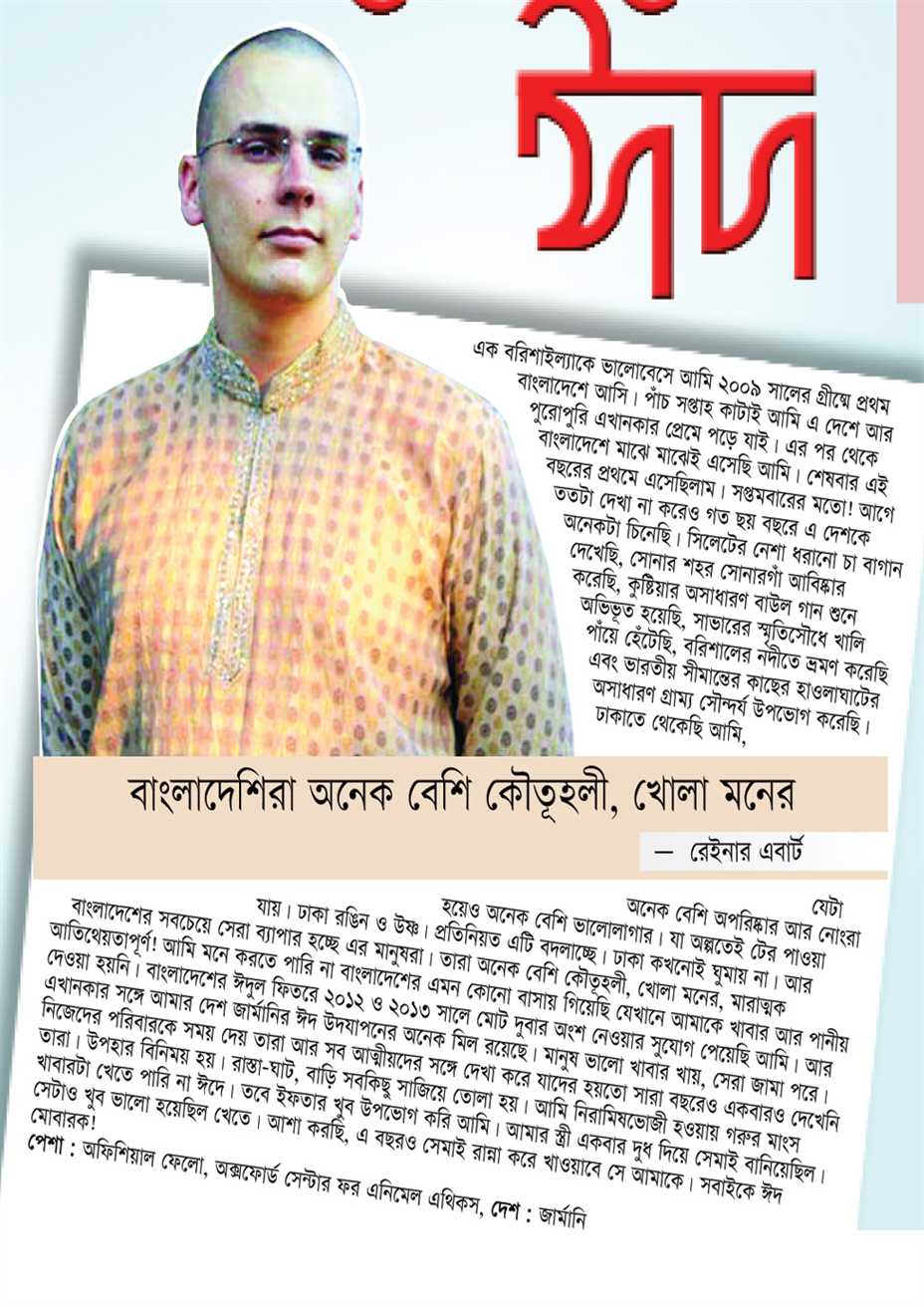
I am featured in this year’s special Eid issue of the Bangladesh Pratidin, a daily Banga-language newspaper in Bangladesh that has a circulation of 550,000. They asked me about my relationship with Bangladesh, and the upcoming Eid festival. Here is what I said, for those who are interested and cannot read Bangla: Continue reading “Eid Mubarak!”→
Last month, the United States Supreme Court made same-sex marriage legal in all fifty states of the Union, and the District of Columbia, adding the United States to the list of nearly two dozen countries, mostly in Europe and the Americas, that recognize marriage between a man and a man, and between a woman and a woman. The decision, which is nothing short of historic, made waves around the globe, including in Bangladesh, and is a cause for celebration for everybody who believes in equal human dignity. Continue reading “Marriage equality in Bangladesh”→
I strongly condemn today’s slaughter of thousands of dogs for the Yulin Dog Meat Festival in the southern Chinese province of Guangxi. Some dogs are being boiled alive, some are being beaten to death, and some are being skinned alive. All dogs suffer, more than anybody ever should, and all are eaten. Continue reading “The Yulin Dog Meat Festival and our double standards”→
Detail from The School of Athens by Raphael, with Plato & Aristotle at the center
Founded around 387 BCE, Plato’s Academy continued throughout the Hellenistic period until the death of its last head, Philo of Larissa, in 84/83 BCE. The most famous student during that time was Aristotle, who after studying at the Academy for almost twenty years went on to tutor Alexander the Great in 343 BCE, and then started to teach at the Lyceum in 335/334 BCE. A group of Neoplatonist philosophers revived the Academy at the beginning of the fifth century CE, and it again flourished until 529 CE, when an edict of the Emperor Justinian I. brought about the closing of all institutes of higher learning in Athens. The Academy was one of the earliest such institutes in the Western world. Besides what we now call philosophy, the subjects taught likely included physics, mathematics, and astronomy. Today, the archaeological site of Plato’s Academy is in a sad state of neglect: trash, eroding walls, rusty fences or no protection at all, and only very few informational sign boards. Given the current financial crisis in Greece, this is unlikely to change anytime soon. Continue reading “The archaeological site of Plato’s Academy in Athens”→