Wanyama wengine ambao binadamu huwatumia kwa chakula, katika sayansi, huwawinda, huwakamata, na kuwanyanyasa kwa namna mbalimbali, wana maisha yao binafsi ambayo yana thamani kwao wenyewe na sio tu kwa sababu ya matumizi yao kwetu. Sio tu kwamba wapowapo duniani, bali wanaufahamu. Wanachokipitia kina maana kwao. Kila mnyama ana maisha ambayo yanaweza kuwa mazuri au mabaya kulingana na namna anavyotendewa.
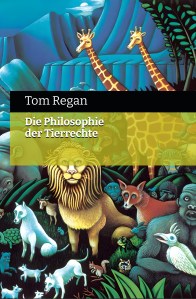
Tom Regan war einer der Begründer der Philosophie der Tierrechte. In seinem Text The Philosophy of Animal Rights, den ich hier neu ins Deutsche übersetzt habe, bietet er eine kompakte Zusammenfassung dieser Philosophie. Ausgangspunkt für Regans Argument ist die Tatsache, dass viele nichtmenschliche Tiere – ebenso wie Menschen – ein Leben haben, das für sie selbst von Bedeutung ist. Sie besitzen ein geistiges Innenleben, können Freude und Leid erfahren und haben daher einen Eigenwert, der unabhängig von ihrem Nutzen für den Menschen besteht.
Die Tiere, die von Menschen gegessen, in der Wissenschaft verwendet, gejagt, mit Fallen gefangen und auf vielerlei andere Weise ausgebeutet werden, haben ein eigenes Leben, das ihnen wichtig ist, unabhängig von ihrem Nutzen für uns. Sie existieren nicht nur in der Welt, sie sind sich der Welt bewusst. Was mit ihnen geschieht, ist für sie von Bedeutung. Jedes Tier hat ein Leben, das für das Tier selbst besser oder schlechter verlaufen kann.
The other animals humans eat, use in science, hunt, trap, and exploit in a variety of ways, have a life of their own that is of importance to them apart from their utility to us. They are not only in the world, they are aware of it. What happens to them matters to them. Each has a life that fares better or worse for the one whose life it is.
In December 2024, Motlatsi Khosi, Kala Bopape, and I organized an international animal ethics conference, Humans and Other Animals: Rattling the Paradigm, with the aim of creating a space where students and early career practitioners, particularly from the Global South, could meet and explore the complex relationship between humans and other animals.
After the conclusion of the conference, the presenters were invited to work their presentations into publishable papers. The result is a special issue of the Bangladesh Journal of Bioethics, which has just been published and is available here. It contains the following articles, all of which are open access:
অন্য যেসব প্রাণীকে মানুষ খায়, বিজ্ঞানে ব্যবহার করে, শিকার করে, ফাঁদ পেতে ধরে এবং বিচিত্র উপায়ে শোষণ করে, আমাদের কাছে তাদের উপযোগিতা ছাড়াও তাদের একটি স্বকীয় জীবন রয়েছে যা তাদের কাছে গুরুত্বপূর্ণ। তারা যে শুধু পৃথিবীর মাঝে অস্তিত্বশীল তা-ই নয়, তারা এ ব্যাপারে অবগতও বটে। তাদের জীবনে যা ঘটে তা তাদের কাছে গুরুত্বপূর্ণ। প্রত্যেকের একটি জীবন আছে যা জীবনধারীর কাছে উৎকৃষ্টতর বা নিকৃষ্টতররূপে প্রতিভাত হতে পারে।
78 abstracts from numerous countries were submitted in response to our call for abstracts, out of which nine were selected for presentation. On each conference day, there will be three sessions of 45 minutes.
The conference language is English. Attendance is free, and anybody anywhere is welcome to join! If you would like to attend, please register using this form no later than Friday, December 13, 2024.
You can find the complete program on our conference website. For a PDF copy, please click here. A poster is available here.
When people are treated monstrously, we say they are “treated like animals.” This is because we treat animals monstrously. We mistreat and abuse them on farms, transport them in cramped and stressful conditions, torture them in laboratories, hunt them for sport, and use them for our entertainment in circuses and zoos. You know that, I know that, everyone knows that. And yet, the horror continues, and it continues on a scale that is truly mind-boggling.
I only now learned that American philosopher Carl Cohen passed away earlier this year, at the age of 92. He was buried at Forest Hill Cemetery in Ann Arbor, Michigan.
Carl speaking at the University of Heidelberg on July 26, 2006The title of Carl’s presentation was “Why Animals Do Not Have Rights”
I first met Carl in July 2006, when he spoke at a conference about the moral status of animals at the University of Heidelberg. Even though I thought he was dead wrong about animals, his passion for philosophical debate and his genuine appreciation of reasoned disagreement made a lasting impression on me, and shaped how I think about the nature and role of philosophy. He was a true champion of diversity of opinion and did not shy away from opinions that are unpopular. If that is where he thought the best arguments lead, that is where he went. He publicly and forcefully argued against affirmative action in college admissions, and for the right of neo-Nazis to march in Skokie, a Chicago suburb where a significant number of Holocaust survivors lived. Like Socrates and any philosopher worth their salt, he was a troublemaker.
Animal Liberation, a 1975 book by Australian philosopher Peter Singer, is widely considered one of the founding texts of the modern animal liberation movement. It develops a new ethics for our treatment of nonhuman animals, according to which their interests should be given the same consideration as the like interests of humans, and calls for an end to practices such as factory farming and animal testing. The book has had a lasting impact on generations of scholars and students and has influenced countless people in all corners of the world to adopt a vegan diet.
Almost half a century after its first publication, Animal Liberation is now finally available in Swahili! The book was translated by Deogratius Simba and published by Dar es Salaam-based publisher Mkuki na Nyota. It is available for purchase at the TPH Bookshop at 24 Samora Avenue in Dar es Salaam, and everywhere else where Mkuki na Nyota’s books are sold. The retail price is 30,000 TSh. If you are a student at the University of Dar es Salaam (UDSM), you can find a copy of the book at the library of UDSM’s Department of Philosophy and Religious Studies.
If the ultimate test of our humanity is how we treat nonhuman animals, then we are failing spectacularly. Earth is home to vastly more farm animals than wild mammals and birds, and almost all of them live in factory farms – where conditions vary from horrible to horrific – and die violently. The sheer numbers make our treatment of animals one of the most pressing moral issues of our time. You do not need to be an animal rights advocate to recognize this truth. If you believe that animals have any moral standing at all, that unlike stones they matter, at least a little bit, then the monstrous amount of gratuitous suffering we routinely inflict on animals should offend your moral sense. A Gallup poll found that a majority of Americans in fact are either somewhat or very concerned about the way in which the animals we raise for food are treated, and extend that concern to the animals used in entertainment and research as well.
The Montreal Declaration on Animal Exploitation is a public condemnation of animal exploitation. As of now, more than 500 researchers in moral and political philosophy from across the globe and various philosophical traditions have signed the Declaration. I am one of them. In philosophy, such agreement is rare. Its part of a growing consensus that common human practices that involve treating non-human animals as mere commodities are fundamentally unjust and morally indefensible.
My new article in the Zeitschrift für Ethik und Moralphilosophie (Journal for Ethics and Moral Philosophy) is perhaps the most important article I have written to date. It builds on arguments I made in previous publications – including in this article and this article – and presents a novel account of full and equal moral status, according to which it is no less seriously wrong to kill a non-human conscious animal than it is to kill you or me.
Peter Singer‘s Animal Liberation, a modern classic in the field of ethics, is now available in Bangla! It is one of the most important books that you will ever read. It might change your life. It did change mine.
প্রাণিমুক্তি
প্রাণিমুক্তি আন্দোলনের বিজ্ঞানসম্মত প্রামাণিক ধ্রুপদী গ্রন্থ
The way we live, and the norms, beliefs, and attitudes that shape our behavior are constantly changing. Much of that change is driven by people who refuse to accept the status quo and rise to ask critical questions about what is right and wrong in how governments, communities, and individuals treat others, including members of sexual, racial, religious, and other minorities, dissidents, people with disabilities, women, nonhuman animals, and the natural environment.
The Centre de Recherche en Éthique (CRÉ) in Montréal, Canada, will unite students from across the globe to come together to explore the ethical considerations around social and political activism, and strategies to achieve local and global change. The conference aims to allow students to exchange ideas across borders and make sustainable connections with each other as well as with the CRÉ.
The conference will be conducted online via Zoom on Tuesday and Wednesday, 7 and 8 December 2021.
Arguments are sometimes criticized as begging the question. An argument is said to beg the question if the conclusion is taken for granted in the premises. The conclusion, however, is implicit – and hence, in a sense, “taken for granted” – in the premises of every deductively valid argument. That has led some philosophers to conclude that begging the question is not a formal fallacy, as otherwise every valid argument would be fallacious. In my latest article, which was just published in Philosophy and Progress, I argue that this conclusion has been drawn too quickly and propose an epistemic criterion that distinguishes between good and bad valid arguments.
Earlier this month, when the news broke that Lars Vilks tragically died in a car crash, comments sections from Bangladesh to Tanzania, from Indonesia to Pakistan, erupted in gleeful celebration. Vilks was the Swedish artist who in 2007 stirred worldwide controversy with a series of drawings that depicted Muhammad as a dog. One of the most common reactions to his death was “Alhamdulillah,” an Arabic phrase that means “Praise be to God.” I am not a theologian by any means, but doesn’t that border on blasphemy? After all, praising God for the car crash implies that God had a hand not only in the death of Vilks, but also in the death of the two members of his security detail who had nothing to do with the offensive drawings, and were just doing their job. One commentator proclaimed that he “bought a cake to celebrate,” and there was plenty of language used by other commentators that cannot be reproduced in a decent newspaper. Comments sections of course are not exactly known for nuanced and intelligent discussion. Rather, they often bring out the worst in people, and I am reasonably confident that the vast majority of Muslims do not share the jubilant attitude toward the death of Vilks and the two police officers. Yet, that attitude still seems to be prevalent enough to warrant reflection.
Philosophy is often dismissed as impractical and of little relevance to everyday life. But the reality of business speaks a different story. Some of the most successful entrepreneurs come from a philosophy background. Philosophers pay attention to every minute detail of a problem, yet don’t lose sight of the bigger picture, and have a unique set of skills that enables them to drive innovation and makes them valuable assets for any business.
I caught up with five of my former students at the University of Dar es Salaam who are now up-and-coming entrepreneurs, and I asked them about philosophy and their experiences as philosophers in business.
L’article résume les principaux arguments de certaines de mes récentes recherches en éthique animale. Je soutiens que l’idée qu’il existe une différence moralement pertinente entre les humains et les autres animaux est incompatible avec la science moderne. Merci beaucoup à Valéry Giroux et surtout à François Jaquet pour la traduction, et merci également à Shamima Lasker pour avoir autorisé la réimpression de cet article en français.