
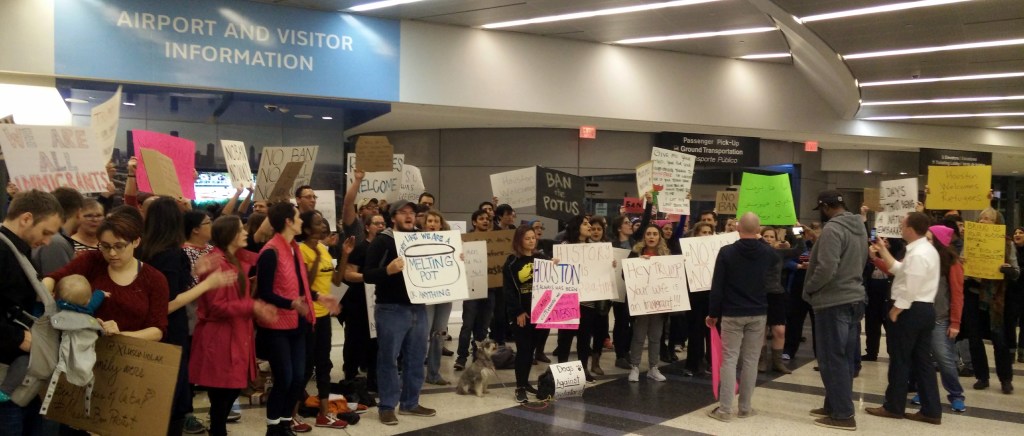
Just a week after Donald Trump first took office as President, he signed Executive Order 13769 – his first travel ban. It halted refugee admissions and suspended entry into the U.S. for citizens of Iran, Iraq, Libya, Somalia, Sudan, Syria, and Yemen. All of these countries have a Muslim majority. Because of that, and also because Trump had previously said that he intends to ban Muslims from the U.S., critics referred to the order as a “Muslim ban.” The backlash was immediate and broad, coming from Republicans and Democrats alike, as well as U.S. diplomats, business leaders, universities, faith groups, and international organizations such as the United Nations and Amnesty International. Protests erupted in airports and cities across the U.S. A friend and I – both of us immigrants to the U.S. ourselves – spontaneously drove to the international airport in Houston to express our outrage, along with hundreds of other protesters. I remember I felt hopeful. Surely, even people who didn’t come out to the airport would recoil once they learned what the order was actually doing to real human beings – for example, to the 78-year-old Iranian grandmother, certainly not a threat to national security, who came to the U.S. with a valid visa to visit her children, as she did every year. She was detained for 27 hours at LAX, denied access to lawyers, and fell ill before finally being allowed to enter the country.
Continue reading “Authoritarianism by exhaustion: Trump’s new travel ban”
 Rainer Ebert