
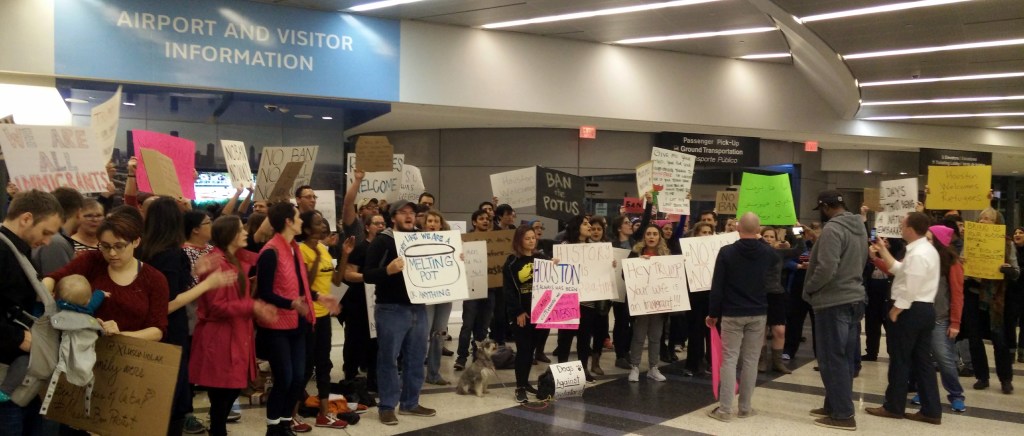
Just a week after Donald Trump first took office as President, he signed Executive Order 13769 – his first travel ban. It halted refugee admissions and suspended entry into the U.S. for citizens of Iran, Iraq, Libya, Somalia, Sudan, Syria, and Yemen. All of these countries have a Muslim majority. Because of that, and also because Trump had previously said that he intends to ban Muslims from the U.S., critics referred to the order as a “Muslim ban.” The backlash was immediate and broad, coming from Republicans and Democrats alike, as well as U.S. diplomats, business leaders, universities, faith groups, and international organizations such as the United Nations and Amnesty International. Protests erupted in airports and cities across the U.S. A friend and I – both of us immigrants to the U.S. ourselves – spontaneously drove to the international airport in Houston to express our outrage, along with hundreds of other protesters. I remember I felt hopeful. Surely, even people who didn’t come out to the airport would recoil once they learned what the order was actually doing to real human beings – for example, to the 78-year-old Iranian grandmother, certainly not a threat to national security, who came to the U.S. with a valid visa to visit her children, as she did every year. She was detained for 27 hours at LAX, denied access to lawyers, and fell ill before finally being allowed to enter the country.
Today, nine years later and one year into the second Trump presidency, I’m less hopeful. On the first day of 2026, a proclamation signed by Trump took effect, expanding an earlier travel restriction to 39 countries. Citizens of these countries, as well as holders of travel documents issued by the Palestinian Authority, are generally barred from obtaining visitor, student, exchange, or immigrant visas. Turkmenistan is a partial exception: its citizens may obtain nonimmigrant visas such as tourist, student, or exchange visas, but immigrant visas remain suspended. The other countries subject to the ban are Afghanistan, Angola, Antigua and Barbuda, Benin, Burkina Faso, Burundi, Chad, the Republic of the Congo, Côte d’Ivoire, Cuba, Dominica, Equatorial Guinea, Eritrea, Gabon, the Gambia, Haiti, Iran, Laos, Libya, Malawi, Mali, Mauritania, Myanmar, Niger, Nigeria, Senegal, Sierra Leone, Somalia, South Sudan, Sudan, Syria, Tanzania, Togo, Tonga, Venezuela, Yemen, Zambia, and Zimbabwe. Together, they make up about twenty percent of the world’s countries.
Despite affecting far more people than the 2017 ban, this one passed almost without notice: no airport protests, no sustained outrage, and little public awareness that it had happened at all. This is partly because it has become impossible to keep up with the incessant noise coming from the White House, which Trump’s former chief political strategist Steve Bannon has explained is strategic: “The real opposition is the media. And the way to deal with them is to flood the zone with shit.” As the noise about the Nobel Peace Prize, the “War on Christmas,” shower pressure, and wind turbines causing cancer absorbs public attention, Trump advances a steady program of norm-breaking and lawlessness. The ongoing extrajudicial killings of people on boats in the Pacific and the Caribbean, the illegal abduction of Nicolás Maduro, the threats against Greenland, the masked federal agents terrorizing communities across the U.S., the separation of families and disappearances of people to inhumane prisons at home and abroad, and the cuts in foreign aid that have already cost countless lives are just some examples. In normal times, none of these would be partisan issues. But these are not normal times.
As understandable and human it is that many of us are worn down by a sustained state of outrage, we must pay attention and cannot allow exhaustion to harden into indifference. Silence is complicity, and complicity is not an option.
On a human level, the January 1 travel ban means this: Students who earned admission to U.S. universities and secured funding after years of studying and planning are now barred from enrolling, losing scholarships and life-changing educational opportunities. Students who already started academic programs in the U.S. and traveled home to renew their visas cannot return to finish their degrees. Parents with lawful status in the U.S. are unable to have their children abroad come and join them, leaving families indefinitely separated. Children are prevented from traveling to the U.S. to sit with a dying parent, attend a funeral, or provide end-of-life care. Married couples, fiancés, and partners are forced into separation. Patients who rely on specialized or life-saving treatment available only in the U.S. are prevented from entering. Professionals and academics are unable to attend conferences. Entrepreneurs and businesspeople are blocked from attending critical meetings or negotiating deals. Entire populations are labeled as dangerous or undesirable, reinforcing discrimination and social exclusion both inside and outside the U.S.
This is not an exhaustive list, but merely a snapshot of the devastating and entirely predictable consequences of Trump’s new travel ban. Like its predecessors, it is not a security measure. It is a choice to inflict harm on ordinary people, and this choice is deliberately cruel. As I’m writing this, the Trump administration has announced a further escalation: the suspension of immigrant visas for 75 countries, a move that primarily affects families by closing the door on reunification. If we meet such policy choices with silence, authoritarianism has already won.
Versions of this article were published under the following titles:
- “Resisting Authoritarianism by Exhaustion: Why We Must Fight Trump’s New Travel Ban,” Common Dreams (USA, 15 January 2026)
- “Resisting authoritarianism by exhaustion: Why we must fight Trump’s new travel ban,” Dhaka Tribune (Bangladesh, 17 January 2026)
- “Travel bans: a reflection on Trump’s immigration legacy,” Weekend Argus (South Africa, 17 January 2026)
- “Resisting authoritarianism by exhaustion: Why we must fight Trump’s expanded travel bans,” The New Daily (Australia, 18 January 2026)
- “Trump takes a dangerous step towards authoritarianism,” The Star (South Africa, 19 January 2026)
- “Authoritarianism by exhaustion — Trump’s new travel ban,” Daily Maverick (South Africa, 19 January 2026)
- “A dangerous step towards authoritarianism,” Daily News (South Africa, 19 January 2026)
- “A dangerous step towards authoritarianism,” Cape Argus (South Africa, 19 January 2026)
- “Authoritarianism by exhaustion,” The Mercury (South Africa, 20 January 2026)
- “Still on Trump’s new travel ban,” Blueprint Weekend (Nigeria, 24/25 January 2026)
- “Authoritarianism by exhaustion: Trump’s new travel ban,” New Telegraph (Nigeria), 28 January 2026
 Rainer Ebert