
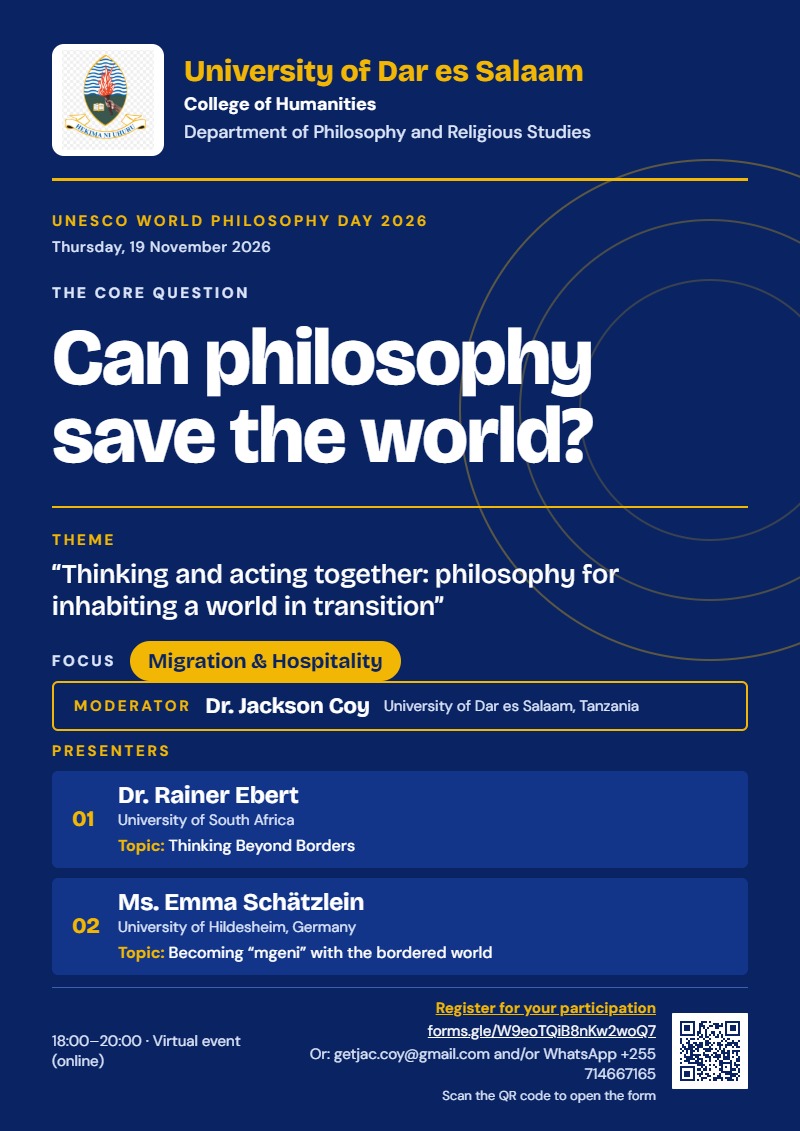
In 2026, World Philosophy Day falls on November 19. It was established by UNESCO to draw attention to the value of philosophy, which the UN agency describes as follows:
Philosophy is an inspiring discipline as well as an everyday practice that can transform societies. By enabling to discover the diversity of the intellectual currents in the world, philosophy stimulates intercultural dialogue. By awakening minds to the exercise of thinking and the reasoned confrontation of opinions, philosophy helps to build a more tolerant, more respectful society. It thus helps to understand and respond to major contemporary challenges by creating the intellectual conditions for change.
The Department of Philosophy and Religious Studies at the University of Dar es Salaam in Tanzania will mark the occasion with a virtual event exploring the question, Can philosophy save the world?
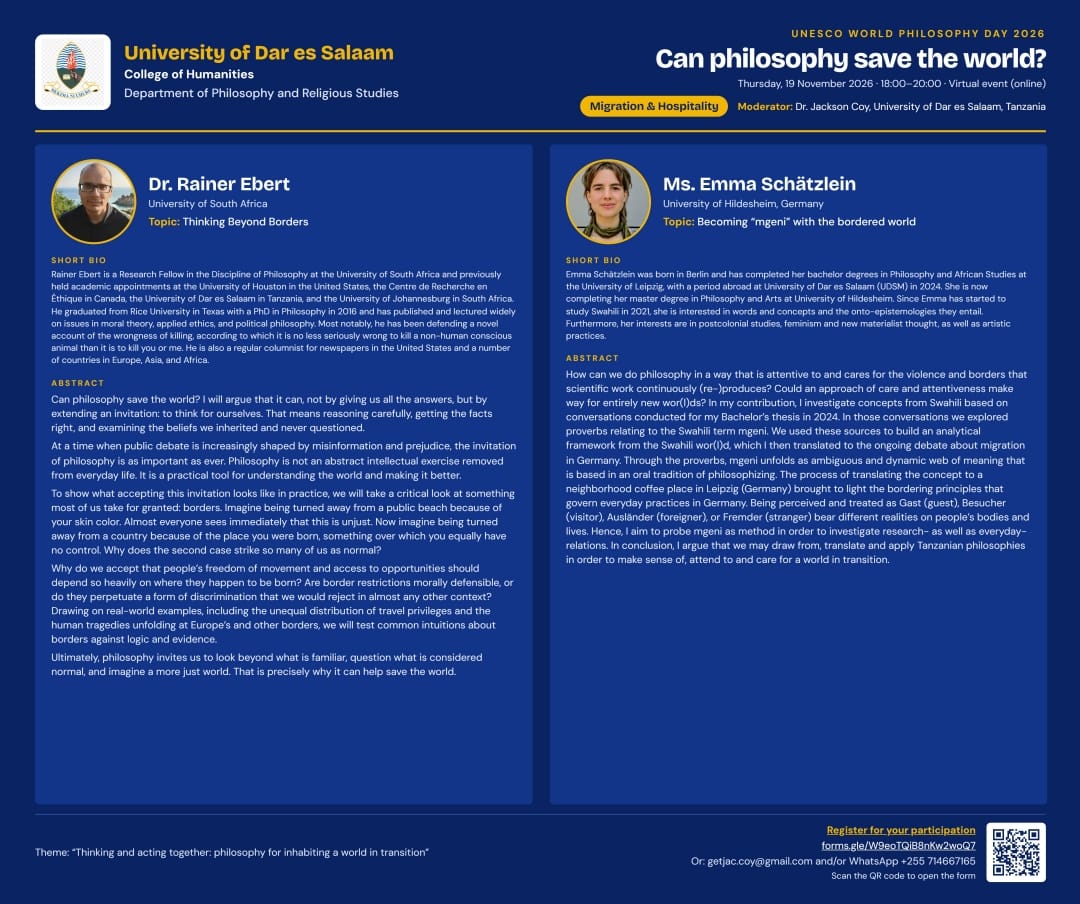
I am delighted to have been invited to deliver a keynote address at the event, alongside Emma Schätzlein of the University of Hildesheim. My talk will explore what it means to think beyond borders, both figuratively and literally. Here is the abstract:
Can philosophy save the world? I will argue that it can, not by giving us all the answers, but by extending an invitation: to think for ourselves. That means reasoning carefully, getting the facts right, and examining the beliefs we inherited and never questioned.
At a time when public debate is increasingly shaped by misinformation and prejudice, the invitation of philosophy is as important as ever. Philosophy is not an abstract intellectual exercise removed from everyday life. It is a practical tool for understanding the world and making it better.
To show what accepting this invitation looks like in practice, we will take a critical look at something most of us take for granted: borders. Imagine being turned away from a public beach because of your skin color. Almost everyone sees immediately that this is unjust. Now imagine being turned away from a country because of the place you were born, something over which you equally have no control. Why does the second case strike so many of us as normal?
Why do we accept that people’s freedom of movement and access to opportunities should depend so heavily on where they happen to be born? Are border restrictions morally defensible, or do they perpetuate a form of discrimination that we would reject in almost any other context? Drawing on real-world examples, including the unequal distribution of travel privileges and the human tragedies unfolding at Europe’s and other borders, we will test common intuitions about borders against logic and evidence.
Ultimately, philosophy invites us to look beyond what is familiar, question what is considered normal, and imagine a more just world. That is precisely why it can help save the world.
The event is scheduled for November 19, 6-8 PM East Africa Time (EAT).
You are welcome to attend! To register, please complete this registration form.

