
When Samia Suluhu became President in 2021, there was real hope that Tanzania would move away from the oppressive authoritarianism of her predecessor, John Magufuli, and toward a more democratic style of governance. Three years later, little hope is left.

In just the last ten days, Tanzania’s democracy has suffered two serious blows. The first occurred in Dar es Salaam on September 23, when police were deployed in large numbers to prevent peaceful protests against killings and abductions of government critics, and opposition leaders, as well as journalists covering the protests, were arrested. The second blow came just hours ago from the Tanzania Communications Regulatory Authority (TCRA), which suspended the online media services licenses previously issued to the country’s leading newspapers, The Citizen and Mwananchi. The reason for the suspension is an animated video published on October 1. It shows Suluhu watching citizens lament the disappearances of family members on TV.
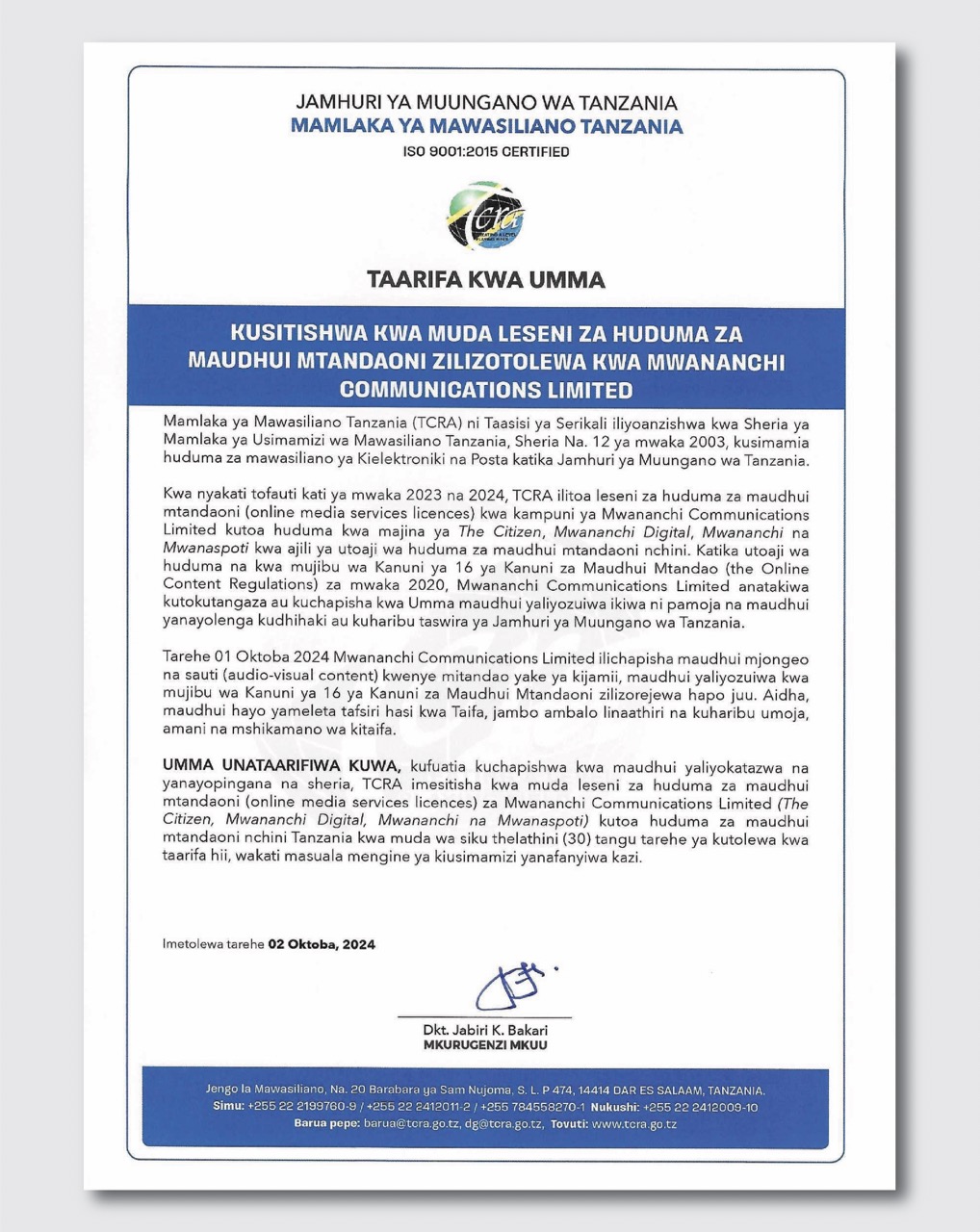

In its public notice announcing the suspension, TCRA quotes Regulation 16 of the Electronic and Postal Communications (Online Content) Regulations 2020, which pertains to prohibited content. Specifically, the notice talks about “content that is against the public order, content that aimed to ridicule and harm the reputation, prestige and status of the United Republic” and “content [that] threatens and is likely to affect and harm national unity and social peace of the United Republic.”
The underlying logic seems to be that it is talking about the recent disappearances of government critics that harms Tanzania’s reputation, national unity, and social peace, rather the fact that the Suluhu government has been unable or unwilling to protect its critics from being killed and abducted, or may even be complicit in these crimes. This is absurd, and an obvious and blatant attempt to intimidate the media, which is especially troubling in view of next month’s local government elections, and next year’s presidential and parliamentary elections.
TCRA’s complete ban on any and all online publishing by two of Tanzania’s leading newspapers is further unconstitutional. Article 18 of the Constitution of the United Republic of Tanzania guarantees the right to freedom of expression, which it explicitly says includes “a right to be informed at all times […] of issues of importance to the society” – such as the recent disappearances.
But there is a silver lining: In the span of less than two weeks, Suluhu has thoroughly dispelled the illusion that she and her government are serious about reversing Magufuli’s authoritarianism, and both the citizens of Tanzania and the world have taken notice.
 Rainer Ebert