

Two colleagues at the University of South Africa – Motlatsi Khosi and Kala Bopape – and I are organizing an international animal ethics conference for students and early career practitioners, which will be held online on December 17, 18, and 19, 2024.
The conference is organized around three themes:
- Philosophy and Ethical Theory
- Activism and Community-centered Approaches
- Cultural Production, Art, and Performance
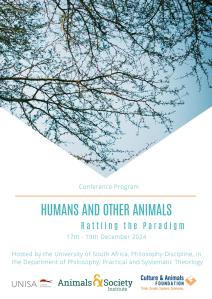
78 abstracts from numerous countries were submitted in response to our call for abstracts, out of which nine were selected for presentation. On each conference day, there will be three sessions of 45 minutes.
The conference language is English. Attendance is free, and anybody anywhere is welcome to join! If you would like to attend, please register using this form no later than Friday, December 13, 2024.
You can find the complete program on our conference website. For a PDF copy, please click here. A poster is available here.
Abstracts and speaker bios
A Two-Factor Framework for the Wrongness of Killing
Tania Aiyar (University of California, Davis, USA)
Many of us would agree with one or more of the following intuitions: (1) We have stronger reasons not to kill some animals than others, forming an animal hierarchy. (2) For some species, we have stronger reasons not to kill a young adult than an old one. (3) We have roughly equal reasons not to kill any two human adults. I show that existing accounts of moral status have trouble reconciling these intuitions. One exception, however, is Jeff McMahan’s account. McMahan posits two factors for the moral status of an organism: its interests and its psychological capacities. In this talk, I propose a revision of how these factors interact, namely, as psychological capacities increase, they acquire increasing weight relative to the organism’s interests. This framework vindicates the intuitions more elegantly, avoiding the arbitrary thresholds of McMahan’s model and their counterintuitive implications. I proceed to show that my framework can be adapted to accounts of moral status that posit different factors, providing a broader solution to the problem of reconciling these intuitions.
Tania Aiyar is an undergraduate philosophy major at the University of California, Davis. Earlier this year, she was awarded first place in the UC Davis undergraduate philosophy essay contest. Her primary interest is in normative ethics, specifically concerning the moral status of humans and other animals.
The Status of Animals in Indigenous Bengali Philosophy
Jubayer Hossain (University of Dhaka, Bangladesh)
Bengali people, also known as Bengalees or Bengalis, are an ethnic group native to the Bengal areas in southern parts of Asia who speak Bangla. By recognizing Bengalis as an indigenous community, this presentation seeks to explore the status of animals within indigenous Bengali philosophy, focusing on the multifaceted roles of animals in cultural, historical, and socioeconomic contexts. In indigenous Bengali culture, animals are not only pivotal in agricultural practices and economic sustenance but also hold significant symbolic and ritualistic value as can be deciphered in Bengali folklore, especially religious observances. Different animals are assigned important roles to enhance agricultural productivity and economic development. For instance, animals hold significant religious positions and are crucial to ways in which Bengali indigenous culture deeply intertwines with Hindu and Muslim traditions. Moreover, in Bengali-Hindu tradition, cows are considered sacred, symbolizing non-violence and motherhood, and are treated with reverence as the goddess Kamadhenu, a divine cow that grants wishes. In contrast, during the Eid al-Adha festival, cows, goats, and sheep are sacrificed to commemorate the willingness of Ibrahim (otherwise known as Abraham) to sacrifice his son in obedience to Allah’s command. This practice highlights the animals’ symbolic role and religious importance. Likewise, many other animals such as snakes, monkeys, elephants, snail, owl, pig cats, tigers, and lions among others, have different statuses in Bengali philosophy. All of this raises ethical issues which will be best addressed from utilitarian and animal rights perspectives.
Jubayer Hossain is an undergraduate student in the Department of Sociology at the University of Dhaka in Bangladesh. His academic interests are in Cultural Anthropology, Gender Studies, and Migration Studies. Currently, he is working on a research project entitled “Foreign Labor Migration and Social Change in Rural Bangladesh.”
Interrogating the Ontologies of Animal Totems (Dogs and Opheodrys) in Tiv Culture
Terkura Thomas Mchia (Benue State University, Makurdi, Nigeria)
This presentation seeks to understand the relationships between dogs and opheodrys, these totems, and their special status among the Tiv people of Central Nigeria. The desire and love of meat drove their ancestors to a culture of hunting and farming to ingratiate this insatiable need. However, respect and conservation of a select breed of animals calls for a close study and special attention. The Tiv share a common cosmological history and ontology with animals like dogs and opheodrys. These animals are considered sacred and respected totems that the Tiv are forbidden to Kill and eat. I seek to answer the following questions. How do Tiv people perceive the agency and special status of dogs and opheodrys in their culture area? What role is played by animals in Tiv spiritual and cultural traditions? How do Tiv people balance their relationships with dogs and opheodrys in their everyday life? What ethical implications arise from these ontologies, particularly regarding animal rights, welfare, and conservation? These research questions will open diverse perspectives to the discourse on African animal ethics. My investigation will unveil the diverse perspectives on human-animal relationships and inform the development of African animal ethics that incorporate indigenous knowledge systems. I will adopt a historicist, cultural, and evaluative approach in answering these. I will argue that there are several similar totems practices in African cultures that can be appropriated and leveraged to liberate non-human animals to establish a regime of a viable African animal ethics.
Terkura Thomas Mchia is an Assistant Lecturer in the Department of Philosophy at Benue State University in Makurdi, Nigeria and a PhD candidate at the University of Nigeria in Nsukka. His research interests include AI ethics, African Philosophy, environmental ethics, and social and political philosophy.
Another one bites the dust: Towards a Community-Centred Approach to Combating Dog-fighting on the Cape Flats
Luvuyo Bomela (University of the Western Cape, South Africa)
This presentation explores the potential efficacy of community-centred approaches to combat the practice of dog-fighting on the Cape Flats. Although dog-fighting is considered an illegal activity, it continues to pervade many communities while posing a threat to the safety and well-being of both canines and humans. While efforts have been made to challenge and combat dog-fighting, it remains a pernicious activity that is largely unregulated.
A community-centred approach entails addressing the issue of dog-fighting by involving ordinary citizens. This strategy involves incorporating “locals,” whose intervention (if trained properly) can be critical in providing emergency first-aid for the dogs, viz, recognising, reporting, and fending off this deadly practice. Community members play a key role in raising awareness, educating the public, lobbying for the implementation of more stringent laws, and facilitating and monitoring enforcement policies to help combat dog-fighting.
This presentation will review various online publications and any other available information produced by the National Council of SPCAs and The Cape of Good Hope SPCA on dog-fighting. A review of various key tactics implemented by community activists to help combat the illegal practice on the Cape Flats will be conducted. These strategies and approaches include collaborations with local authorities, and grassroots initiatives aimed at supporting the implementation of stricter laws to help regulate dog-fighting. Overall, this review aims to demonstrate that community-centred approaches can be proactive and effective in addressing the issue of dog-fighting in our society.
Luvuyo Bomela is a graduate student in the Department of Sociology at the University of the Western Cape in South Africa. His academic interests include sociology and environmental humanities with a peculiar interest in topics such as animal blood sports and dog-fighting.
Social Media and Animal Rights: Analyzing the Evolution of Animal Welfare Movements in Bangladesh
Sarah Israth (University of Dhaka, Bangladesh)
This presentation delves into how social media is revolutionizing animal welfare efforts in Dhaka, Bangladesh, focusing on both community-driven initiatives and legal advocacy. Using qualitative methods such as digital ethnography and semi-structured interviews, my research examines how online platforms are transforming individual acts of animal rescue into broader, organized movements. Theoretical insights from Benedict Anderson’s “Imagined Communities” and Erving Goffman’s Framing Theory shed light on how digital spaces foster collective identities and influence public attitudes. By 2024, local animal welfare groups had evolved from merely rescuing and adopting animals to actively engaging in legal battles and policy advocacy. Noteworthy achievements include successful legal actions against animal cruelty and campaigns against harmful policies like the relocation of stray dogs. I will highlight how social media not only builds strong support networks and raises awareness but also empowers new activists. I will emphasize the crucial role of these digital communities in mobilizing collective action and ensuring that animal rights are upheld. My research enhances our understanding of how digital platforms can drive meaningful social change and offers a framework for applying similar strategies to other advocacy efforts.
Sarah Israth is a dedicated advocate for social and animal welfare, with an academic background in anthropology from the University of Dhaka. She has worked in roles focused on social compliance and governance, while her commitment to both human and animal causes has been evident from a very young age.
Growing Empathy: Inspiring Animal Ethics Through Compassionate Pedagogy
Angie Angel Rengifo (La Quinta Pata, Colombia)
Colombia’s cultural landscape implies a strong speciesist tradition. Because it relies on agro-economy, most people grow up with a realistic picture of how relations with animals work under the speciesist system, in terms of food, entertainment, and work. At the same time, a large part of the Colombian population has also grown up with violence very close to home, especially in vulnerable groups, where security (food, economic, and physical) is not granted.
In this context, where violence is often part of our daily reality, and among normalized animal objectification, La Quinta Pata is born, a collective that proposes a compassionate, non-victimizing, abolitionist, and artistic activism. As a member of La Quinta Pata, I will present a learning experience that has marked us as a group:
In March 2023, we organized an anti-speciesist Fanzine workshop in alliance with La Olla Vegana Popular (a grassroots initiative promoting food justice, veganism, and feminism) and the School Re-creo Sueños (a pedagogical and popular initiative). The workshop was titled “¿En qué me parezco a los animales?” (How am I similar to animals?) and it was directed at a group of children living in the Santa Fé, a neighborhood historically marginalized since its declaration as a red-zone by the city council.
With my presentation I want to share a successful case of vegan pedagogy and activism through the arts. This workshop focused on building empathy while teaching children about nonhuman animals. Considering the social context of its participants and our pedagogical approach, this experience can become a blueprint for other regional initiatives.
Angie Rengifo was born in Bogota, Colombia. She studied visual arts and is currently doing an M.A. in Performance and Digital Arts in Nuremberg, Germany. Since 2021, she has been part of La Quinta Pata, a collective that practices compassionate activism, art, and literature in favor of animal liberation.
Roadside Zoo: Captive Glow
Shannon Johnstone (New Zealand Centre for Human-Animal Studies, New Zealand)
My PhD thesis, The Latent Image: Exposing Suffering and Developing Change (2025), examines what it means to create and view images of animal cruelty especially within contemporary photography. I am particularly interested in situations where suffering is clearly visible, but we choose not to see it, or perhaps we frame the suffering through a different lens. Since roadside zoos are legally sanctioned, open to the public, and they encourage visitors to take pictures, they can be a powerful tool to reframe what it means to look at animal suffering. Roadside zoos are privately owned unaccredited menageries that typically charge an admission fee. They exist in every state in the USA, and they are legal. Through my photography, I hope to picture captive animals as individuals, and create photographs that empathetically call our attention to their boredom, frustration, and suffering. In this presentation, I will discuss my photography project “Roadside Zoo: Captive Glow” which I created while working on the dissertation. Specifically, I will discuss the ethics of creating and looking at animal suffering from a Critical Animal Studies perspective, and use the photographs to discuss issues of power, representation, perception, and empathy. With this work, I hope to dismantle our anthropocentric lens and challenge our sense of entitlement in enslaving wild animals.
Shannon Johnstone is a tenured Professor (art department) at Meredith College in Raleigh, NC, and a Fellow with the Oxford Centre of Animal Ethics. She is also a PhD candidate in Human-Animal Studies at the University of Canterbury in New Zealand where she is examining the role of creating and viewing photographs of animal suffering. Her photographic work deals with themes that reclaim what has been discarded and make visible that which is hidden.
The Disposability of Ritual Animals: Raising the Animal Rights Question around Yoruba Rituals
Sherifdeen Olafimihan (Obafemi Awolowo University, Ile-Ife, Nigeria)
The interests of non-human animals – arguably a category of sentient creatures – appears to be of less concern to Yoruba ritual practitioners. This is a thought that imposed itself on me as a postgraduate research assistant on an anthropological project involving an age-long tradition of animal sacrifice. From what I consider a vantage point of participant-observation, I will interrogate the basis of the prevalent tradition of animal sacrifice in selected rituals of the Yoruba people of Nigeria. Specifically, the rituals will be investigated against the background of objections to speciesism and other debates surrounding it. Hence, the ethical issue which the acts of the ritual raise will be critically discussed from the perspective of animal rights as enunciated by Peter Singer, Tom Regan, Carol J. Adams, and Brigid Brophy.
Sherifdeen Olafimihan earned his Bachelor’s degree in English and International Studies from Osun State University in Nigeria. He is currently pursuing a Master’s degree in English Literature at Obafemi Awolowo University, Ile-Ife. His research interests include oral literature, film studies and criticism, as well as cultural studies.
Commemorating Companion Animals: Practices and Rituals from an Italian Pet Cemetery
Camilla Tumidei (University of Turin, Italy)
Companion animals play significant roles as friends, family members, and life partners. Their importance in human lives is evident when they pass away and is manifested in ritual interventions, funeral practices, and the choices regarding the treatment of their remains. These practices often serve to facilitate the grieving process, which can be difficult to articulate or express. Indeed, there is a notable tension between the deeply personal bond shared between humans and animals and an absence of socially or culturally recognized frameworks that validate the significance of companion animals deaths. How, then, can we arrive at a profound understanding of the consequences of the interweaving of the life and death of humans and non-humans, both on a personal and social level? Drawing from my ethnographic research at an animal cemetery and cremation centre in Sardinia, Italy, with this contribution I intend to share some reflections on how people create spaces to express themselves and to challenge what is considered appropriate in investing time and emotional labour after the death of a companion animal. Within a complex web of practices and narratives, the contribution will trace, in particular, the significance of burial and cremation practices, as well as the ways in which aesthetics and material forms of commemoration present in cemetery space reflect the relationship between humans and animals.
Camilla Tumidei is a PhD student in Social Anthropology at the University of Turin in Italy. She is conducting fieldwork in an animal cemetery and crematorium in Sardinia to understand practices and rituals surrounding animal death.
Mentors
Presenters have been paired with mentors who are experienced academics and will help them prepare for the conference. Mentors will conduct pre-conference workshops, which will provide our presenters with the opportunity to get to know each other, practice their presentations, exchange ideas and receive feedback, ask questions about the conference, and explore venues of collaboration.

Dr Yolandi M. Coetser is a Senior Lecturer in Philosophy at the North-West University School of Philosophy, where she engages in the exploration of environmental philosophy with a particular emphasis on animal ethics. Her research delves into the intricate relationships between humans, animals, and the environment, aiming to foster a deeper understanding of ethical considerations and promote more humane and sustainable practices. Additionally, Dr. Coetser is the founder and chairperson of the South African Society for Environmental Philosophy, through which she has been instrumental in advancing discussions and initiatives related to environmental and animal ethics within the South African context and beyond.

Aragorn Eloff is a PhD student at North West University. His current work develops the notion of psychedelic ontogenesis – a model of psychedelic experience that incorporates enactive cognition, active inference, and Simondon, Deleuze, and Guattari’s philosophies of becoming. Other recent work applies Deleuze and Guattari to anarchist politics, subjectivity, Earth/animal liberation, algorithmic governance, and embodied radical therapy. He is also an experimental musician; his work with generative composition and sonic ecologies can be explored at www.further.co.za.

Dr Yamikani Ndasauka is an Associate Professor in the Department of Philosophy at the University of Malawi. He is an interdisciplinary scholar interested in the intersection of philosophy, ethics, psychology, public health, and cultural studies, with a particular focus on African perspectives. His 2024 book, Technology, the African Mind and Culture: Philosophical Perspectives, provides a philosophical investigation of African technology, articulating conceptual foundations and analyses rooted in African worldviews and communitarian values.

Dr Morufu Omigbule is a folklorist and literary anthropologist with a major focus on the rituals and mythology of the Yoruba of Nigeria and the diaspora. His 2021 book, Rituals of Ilé-Ifè, Nigeria: Narratives and Performances of Archetypes, showcases the artistic, identitarian, immersive, and transformative potency of Yoruba rituals. He is an Oxford University Visiting Scholar, a fellow of Ghent University, Belgium, and an African Humanities Fellow of the American Council of Learned Societies.
The conference is supported by a generous grant from the Culture & Animals Foundation and the Animals & Society Institute.


 Rainer Ebert